
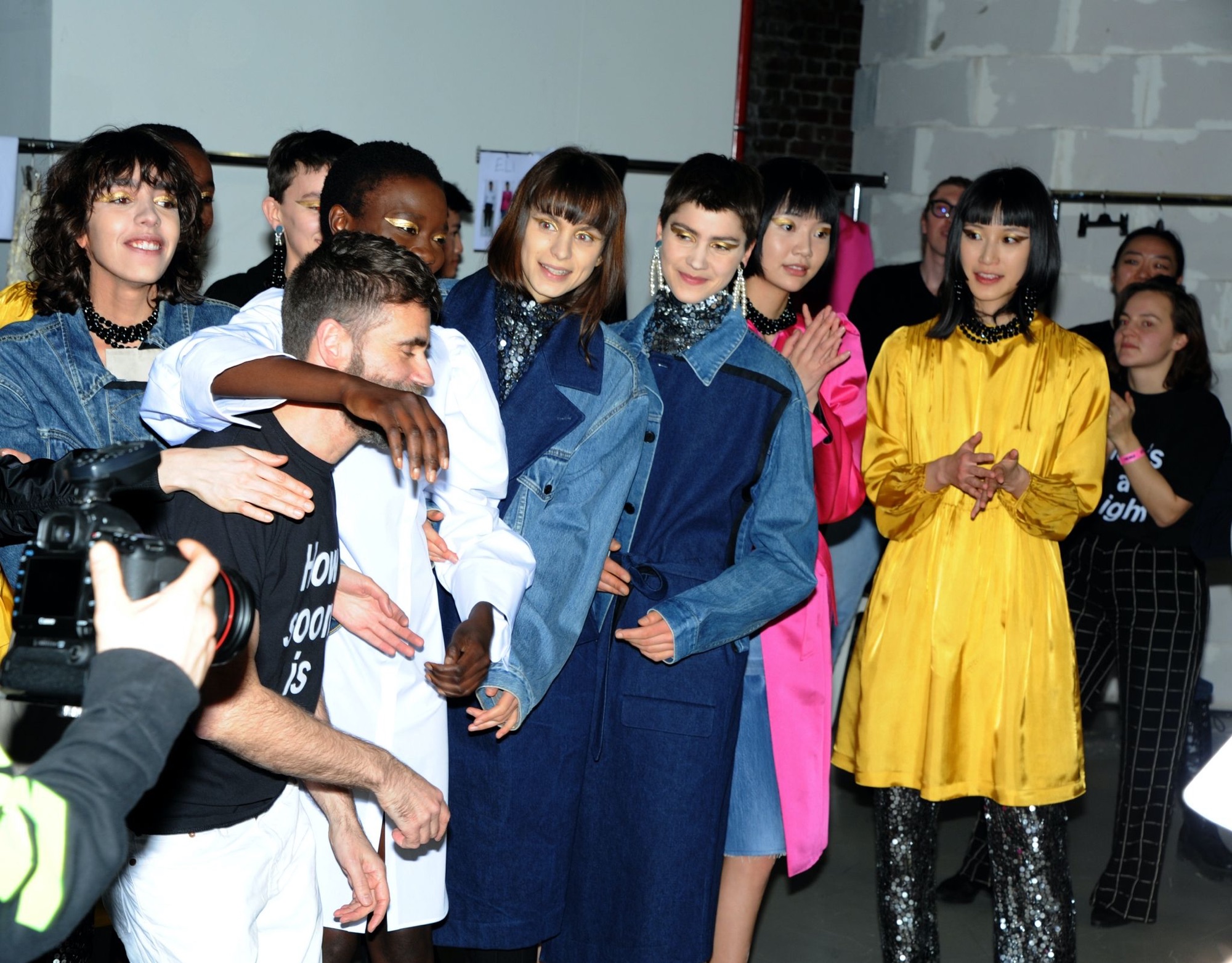
Lutz speaks to JESÚS S Ferrera of SICKY Magazine , April 14th , 2021
read the whole interview here https://sickymag.com/lutz-huelle-fashion-made-for-the-people/
“You’ve always combined your work with your independent brand with working with big and historical brands like Brioni, Delpozo and MaxMara. You have always stood for people who wear the clothes to be the protagonist and not yourself. Do you approach this idea in both your own brand and the others? And also, how do you reach a harmony between working for your own brand and for others?
It is exactly the same way of working, but I’m just dressing a different person. For example, Brioni was easy because it was menswear, it was a very classic man. You just need to think about who you are dressing, but differently. I’ve always seen it as a service: what would be the best thing for this brand and who’s the person who buys this brand. Then the approach is the same.
When working with MaxMara, I just look at what they need, who their customer is, what their DNA is. You just take it from there, and you use the same logic.
When I work for other people it is a service for the client. I can do the mad or crazy things at my own brand. I really like to work for other brands because you just channel your energy differently.
I feel that fashion is an industry with a lot of ego. It’s interesting that you say you want to be at the service of the brand, you don’t want to change it and be in the centre of it.
Yes, but honestly, having my own brand is also kind of an ego. It’s me saying “look what I’m doing, please wear it.” It’s ridiculous in a way, but it’s also about ego. I feel like I can leave my ego in my own brand, and then, in other companies, I do what is right for them.
But it always depends. For example, MaxMara is very easy because they have such a clear Brand DNA, the client is so concrete.
For Delpozo it was about keeping the beauty, but also making it more real. Make it for somebody who’s not on the red carpet, normal people. When I first met the owners of Delpozo they asked me “what would you do with this collection?”, and my response was “I would keep the beauty and unique vision, but make it more accessible for everybody.”
Fashion is always been so aspirational that it is also cool to make it accessible and real.
Yes, and it is nice to show possibilities. Then is up to people to decide if they like these proposals or not. In any case, once the collection is done, there’s nothing you can do. Just hoping that people will like it. Who cares about my ego if nobody is going to wear these clothes.
For your last FW21 presentation, you launched a video in which you were explaining the collection, and you even included a “DIY” kind of tip. It all had sort of an ‘amateur’ look -it was not a big production-. Why did you decide to do it that way?
It was somehow a practical decision. The collection was not available in France because it was still in Japan. I didn’t want to do something that was more than what it was. This collection was very easy, and it wasn’t conceptual at all. I’ve said that before, this is the least conceptual collection I have ever done. Mainly because I felt it was not the right moment to do something conceptual or extreme. I just got tired of anything that was not clear and to the point, times are so complicated anyway that I didn’t want more even more complications. I thought, how can I show this in the most honest way possible? And it was just to explain what was there.
About the DIY video, I had done several videos like that during the first lockdown. There was no more connection with people. When you design clothes, connections are so important. What’s the point of doing clothes if there’s no-one in front of you? I was also getting fed up with this idea that everything you do is to sell. I thought “what if we just give something for free?” Fashion is not only about pushing clothes, it is also about dressing, human interaction, showing people something… It was like “take a t-shirt and make something out of it.” Ignore all the surrounding complications. The easy invention of things.
And then I thought that I wanted to repeat this and just do something generous. That was basically the idea. And people actually reacted so positively. It was really nice to see.
As you said, there was zero production. It was just someone holding an iPhone while I was explaining. To be honest, now I just want to go back to show clothes again. There have been so many discussions about if shows make sense or not. But one thing that I’ve learnt during the last year is that they make incredible sense. It is about looking at something in front of you, it is about the moment, it is about something real that is out there. Filming clothes is so much more organized and controlled. What I like about fashion shows is that they are in real time, unpredictable, surprising.
It is also much more emotional, right?
Yes! A screen doesn’t speak to me in the same way. That’s also one of the reasons for which I did not want to do a more elaborate film showing these clothes; it just does not feel emotional. We already have so many things happening via screens. Honestly, any idea that I came up with just felt wrong and pretentious, not right for the time. Fashion is about people, emotions.
You said this was your least conceptual collection. Reading interviews and looking at past collections, I’ve seen this has been a recurrent theme in your career: the idea of wearability in clothing. How important do you think it is to keep this wearability while maintaining the fantasy that has always been so present in fashion?
It actually depends on the moment. There are moments when you just explore and there are so many ideas, and sometimes there are not. The idea of wearability has always been central to me. Even if it is just one person out of 100 who wears the piece. It is funny that wearability is sometimes a dirty word. But honestly, if nobody wears your clothes what’s the point in designing them?
As long as it stays specific or unique in some way, as long as it conveys a message… Sometimes you do it in a more extreme way and sometimes easier. That’s how I’ve always worked. I always try to do what feels right for me for the moment.
I’ve read that one thing you love about fashion is that every six months there is a renewal. Do you think this constant renewal can co-exist with sustainability? And also, do you think it is affordable for shoppers?
I realized that the idea of remaking everything every six months is completely mad. Or even every three moths, because of pre-collections. But I’m also someone who gets bored very easily with things that become automatic.
When I was fourteen and living in Germany, I worked for three weeks in a factory during a summer holiday. It was literally the worst thing for me, it was so hard. I was doing the same movement all the time, and I was going completely mad. So when I say that I love the idea of renewal every six months it is just psychologically. I need constant change, renewal. I love the idea of going forward, keep your mind working.
The idea that you can completely reinvent yourself every six months is so positive and life-affirming for me. Every six months your life starts again. People sometimes feel like their lives are a constant and non-changeable, and that’s not true at all. The fact that fashion forces you to re-evaluate everything every six months is a life-saver for me.
I can imagine that being an independent brand can sometimes be tough, mainly financially. We constantly see how big companies are absorbing smaller ones. Is that something you have thought about at some point? Or do you think that would mean a loss of creative independence as well?
I think it wouldn’t mean a loss of creativity because when you look at the collections of some very big houses out there, they are incredibly creative. I think creativity is an abstract idea. What you have to do is just make something that makes sense. And it is very important that collections are right for the moment, that they work.
I think you can sell creativity, and you can make a lot of money with creativity. And also, you can lose a lot of money with something that is not creative at all. This whole discussion is old in a way. If you find the right people, you have the same goal, and you understand each other, then the sky is the limit.
Look at Gucci, there is a CEO that understands everything. They all share the same vision and the same idea, then everything makes sense. For me, Gucci is actually an incredible story. I’m sure that not every CEO would’ve understood Alessandro Michèle explaining his vision, but he found somebody who did. And they made a huge success out of it. I think big success today is a mixture of business and creativity.
So we would be absolutely open to it. It is not always easy to be a small brand, especially now. Whenever the market is going through a difficult situation, small bands are the first to have problems. So I’m not someone who says I need to keep being independent to be able to protect my vision. I think my vision is very much compatible with bigger business.
There is something that lately, when I interview someone who is working in the fashion industry, I like to ask. Mainly because we are living such uncertain and changeable times, which would be your utopian fashion industry?
That is really difficult (laughs). I think I have no answer for that. Probably, we just have to be more careful in general when it comes to the human aspect of it all. I also think that people forget the value of a piece of clothing, how much work goes on it. People sometimes think our clothes are expensive, but I always want to say, do you know how much work goes into these pieces? You spent time choosing fabrics, colours, putting things together. You make a drawing, then the first prototype, the second one and sometimes even a third. It takes a lot of time and effort to make a piece of clothing.
If that became a little bit more clear, it would mean an incredible evolution. There’s passion and love behind all of these pieces. “
 lutzhuelle.blog